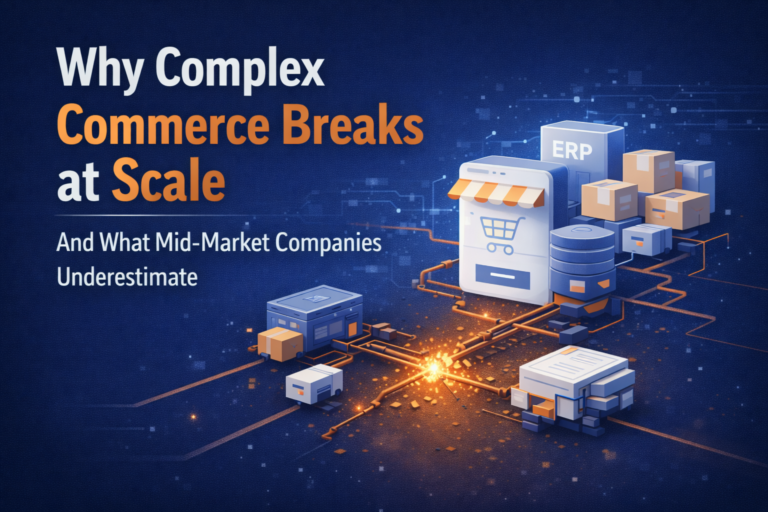
Most mid-market companies don’t set out to build complex commerce systems.
They earn them.
What starts as a straightforward ecommerce initiative – launch a new site, connect it to the ERP, and start selling online – gradually becomes something much larger. Over time, new requirements emerge: customer-specific pricing, multiple warehouses, complex shipping rules, sales rep ordering, portal access, reporting requirements, and integrations to accounting, CRM, and logistics systems.
Individually, each change makes sense. Together, they create complexity that most organizations underestimate.
And that’s why complex commerce systems don’t usually break at launch.
They break at scale.
Complexity Is Earned, Not Chosen
In the early stages, ecommerce is relatively simple:
- One storefront
- One price list
- One warehouse
- Simple shipping rules
- Manual adjustments when needed
But growth changes everything.
As companies grow, they add:
- Customer-specific pricing and contracts
- Multiple fulfillment locations
- Backorders and vendor drop-shipping
- Sales rep ordering and approvals
- Customer portals
- ERP integrations
- Advanced reporting requirements
- Multiple websites or brands
- Marketplace integrations
- Mobile apps and field sales tools
The system that worked at $2M–$5M in online revenue often starts to strain at $10M, and by $20M–$50M it becomes clear that the original architecture was never designed for this level of operational complexity.
This is the moment when leadership starts asking:
“Is our platform the problem?”
Sometimes it is.
But most of the time, the platform is not the first thing that broke.
The Platform Is Rarely the First Problem
When commerce systems struggle, the common reaction is to blame the platform:
- “Shopify can’t handle our pricing.”
- “WooCommerce doesn’t scale.”
- “Our ERP is too old.”
- “We need to replatform.”
In reality, most commerce failures at the mid-market level are not platform failures. They are architecture and ownership failures.
What breaks first is not the storefront.
What breaks first are the connections, assumptions, and processes behind the storefront.
This shows up as:
- Inventory numbers that don’t match between systems
- Orders that fail to sync
- Pricing discrepancies between ERP and website
- Manual processes to “fix” data after the fact
- Finance teams reconciling orders manually
- Operations teams losing trust in the system
These are not checkout problems.
These are systems problems.
Revenue Grows Linearly. Complexity Grows Exponentially.
One of the biggest things mid-market companies underestimate is how quickly operational complexity grows compared to revenue.
Revenue growth feels linear. You add customers, orders increase, and the business grows steadily.
Operational complexity, however, grows exponentially because every new requirement adds new logic:
- New pricing tiers
- New shipping rules
- New customer types
- New approval workflows
- New integrations
- New reporting requirements
Over time, the number of exceptions increases:
- Special pricing for key accounts
- Freight exceptions for large orders
- Inventory allocation rules
- Sales reps overriding pricing
- Manual order adjustments
- Customers who don’t fit the standard workflow
Eventually, the exceptions become the system.
And that’s when things start to feel fragile.
Where Systems Actually Break First: Integrations
Most mid-market commerce environments include several core systems:
- Ecommerce platform (Shopify, WooCommerce, etc.)
- ERP system (Acumatica, NetSuite, etc.)
- Warehouse or fulfillment software
- Shipping systems
- Tax calculation software
- CRM
- Marketing automation
- Reporting tools
These systems rely on integrations to share data:
- Products
- Customers
- Pricing
- Inventory
- Orders
- Shipments
- Tracking
- Invoices
- Payments
Most teams think of integrations as simple connections-something you set up once and move on.
But integrations are not plumbing. They are software products.
They contain business logic like:
- How pricing is calculated
- Which warehouse fulfills an order
- How backorders are handled
- How customers are matched between systems
- When an order is considered “posted”
- How cancellations and refunds sync
And that logic changes as the business evolves.
Without ownership and ongoing maintenance, integrations don’t usually fail all at once. They decay.
This decay shows up as what can be called data drift:
- Inventory that is slightly off
- Pricing mismatches that happen occasionally
- Orders that fail only in certain edge cases
- Customers duplicated between systems
- Financial reports that require manual adjustments
Data drift is more dangerous than a system outage because it erodes trust slowly. Teams begin to rely on spreadsheets and manual checks instead of the system, and the efficiency gains from e-commerce start to disappear.
The Replatforming Trap
When systems become painful, many organizations decide to replatform.
Replatforming feels like progress:
- New technology
- New UI
- New features
- A clean slate
But replatforming often fails to solve the real problem because the real problem usually isn’t the platform-it’s unclear processes, fragile integrations, and accumulated decision debt.
If the business rules are unclear today, they will still be unclear on the new platform.
If pricing logic lives in spreadsheets and tribal knowledge, moving platforms will not fix that.
If integrations are fragile, rebuilding them on a new platform simply recreates the same risk in a new environment.
This is why many companies go through expensive replatform projects and still feel like their systems are fragile a year later.
They moved the technology, but they didn’t fix the architecture or the ownership model.
Decision Debt: The Hidden Cause of Fragile Systems
Most fragile commerce systems are not the result of bad decisions. They are the result of reasonable decisions made over time.
Examples of decision debt:
- “We’ll handle that pricing manually for now.”
- “Let’s just add a plugin for that.”
- “We’ll fix the data model later.”
- “Only one customer needs this workflow.”
- “We can reconcile that in accounting.”
Each decision is logical in the moment. But over time, these decisions accumulate into a system that is difficult to understand and even harder to change.
At scale, decision debt shows up as:
- Slow development cycles
- Fear of making changes
- Frequent edge case failures
- Heavy reliance on a few key people who “know how it works”
- Systems that no longer reflect how the business actually operates
Commerce Is Not a Website. It’s an Operating System.
One of the biggest mindset shifts mid-market companies need to make is this:
Commerce is not a website. Commerce is an operating system.
It connects and impacts:
- Sales
- Customer service
- Operations
- Warehousing
- Shipping
- Finance
- Marketing
- Leadership reporting
When commerce systems are designed like marketing websites, they fail at scale.
When commerce systems are designed like operational infrastructure, they support growth.
This is a fundamentally different way of thinking about ecommerce.
It means decisions about ecommerce are not just design or marketing decisions. They are operational and financial system decisions.
The Ownership Problem
Even when companies have good technology, systems often fail because no one owns the outcome.
A common structure looks like this:
- An agency builds the website
- Internal IT manages servers and security
- Operations manages fulfillment workflows
- Finance manages accounting and reconciliation
- Marketing manages content and promotions
Everyone touches the system, but no one owns the entire system end-to-end.
When something goes wrong, teams spend more time determining whose problem it is than actually solving it.
Healthy mid-market companies treat commerce as a core function with clear ownership and accountability. That ownership can be internal, external, or hybrid – but it must exist.
Because at scale, fragmented responsibility leads to fragmented systems.
What Actually Works at Scale
Companies that successfully scale complex commerce environments tend to do a few things differently:
1. They Design Around Operations, Not Just Checkout
They map how orders flow from customer to fulfillment to accounting and design systems around that flow.
2. They Treat Integrations as Products
Integrations are monitored, documented, and owned. Not forgotten after launch.
3. They Modernize Incrementally
Instead of replatforming every few years, they improve architecture step by step.
4. They Document Business Rules
Pricing logic, fulfillment rules, and workflows are documented and visible, not buried in plugins or tribal knowledge.
5. They Establish Clear Ownership
One team or partner is responsible for the system working as a whole. Not just individual pieces.
The Question Leadership Should Be Asking
When commerce systems start to feel fragile, the question is not:
“What platform should we switch to?”
The better question is:
“Do our systems reflect how our business actually operates today? And are they designed for where we’re going?”
That question leads to better decisions about architecture, integrations, and ownership.
Because complex commerce rarely fails all at once.
It fails slowly.
Then operationally.
Then financially.
Then strategically.
The companies that recognize this early, and treat commerce as infrastructure instead of a website, are the ones that build systems that support growth instead of limiting it.
Final Thought
Mid-market companies don’t struggle with commerce because they lack good people or good tools.
They struggle because success creates complexity, and complexity requires intentional systems, architecture, and ownership.
The goal isn’t to eliminate complexity.
The goal is to manage it on purpose.
That’s what allows commerce to scale from a sales channel into a true operating system for the business.